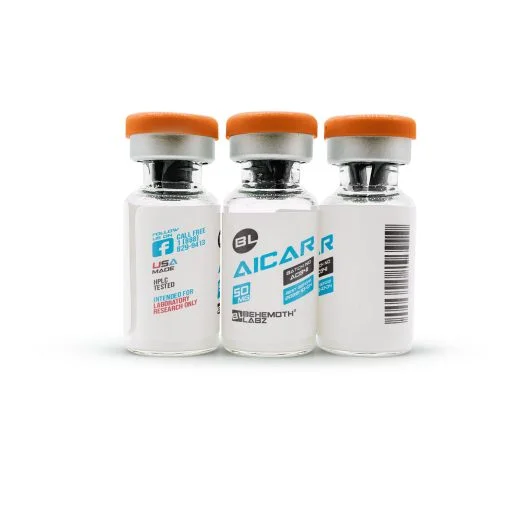
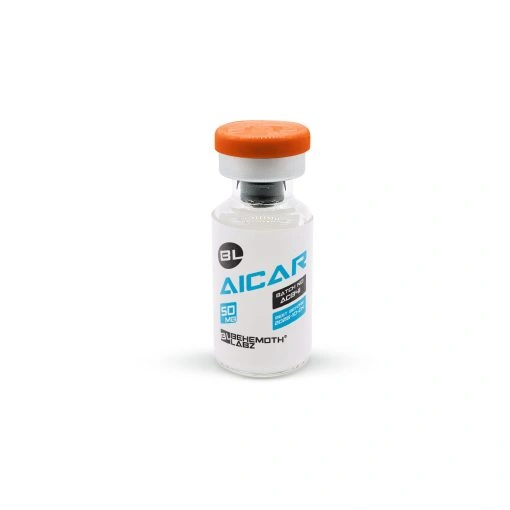
Product Details: AICAR
AICAR (5-Aminoimidazole-4-carboxamide ribonucleotide), also known as acadesine, is an investigational small molecule nucleotide analog commonly supplied as a high-purity lyophilized compound for laboratory and research applications. AICAR is structurally similar to adenosine monophosphate (AMP) and is widely used in experimental systems as a tool to study intracellular energy signaling pathways. [1][2]
AICAR is widely utilized in preclinical and cellular research models to investigate AMPK-mediated signaling pathways and nucleotide-dependent regulatory mechanisms. These studies focus on how AMP analogs influence intracellular signaling processes under controlled experimental conditions. [1][2]
Mechanism of Action
In experimental systems, AICAR enters cells via nucleoside transport pathways and is phosphorylated intracellularly to ZMP. ZMP binds to the γ-subunit of AMP-activated protein kinase (AMPK), mimicking endogenous AMP and promoting activation of the enzyme. This mechanism has been demonstrated in intact cell models and biochemical assays. [1][3]
Activation of AMPK by ZMP leads to phosphorylation of downstream targets involved in cellular energy regulation. AMPK functions as a central energy sensor, and its activation influences pathways that regulate ATP balance and metabolic signaling. AMPK-focused research studies extensively characterize these downstream signaling effects. [4]
AICAR-induced AMPK activation is also used in experimental models to study regulatory signaling cascades linked to transcriptional control. These pathways are investigated in vitro to understand how AMPK activation influences gene expression and intracellular signaling networks under controlled conditions. [4]
Properties of AICAR:
- Molecular Formula: C₉H₁₄N₄O₅
- Molecular Weight: 258.23 g/mol
- CAS Number: 2627-69-2
- PubChem CID: 17561
- Synonyms: AICAR, Acadesine, ZMP precursor, 5-Aminoimidazole-4-carboxamide ribonucleotide
Research Applications/Benefits of AICAR:
-
AMPK Activation Studies
AICAR is widely used in experimental models as a pharmacological activator of AMPK. Studies demonstrate that intracellular conversion to ZMP leads to activation of AMPK, allowing investigation of AMP-dependent signaling pathways in controlled laboratory environments. [1][3]
-
Cellular Energy Signaling Research
AICAR is utilized in in vitro systems to examine AMPK-mediated regulation of cellular energy balance. Research focuses on how AMPK activation coordinates intracellular signaling pathways involved in maintaining energy homeostasis. [4]
-
Nucleotide Analog and Enzyme Interaction Studies
As an AMP analog, AICAR is used to investigate interactions between nucleotide mimetics and AMP-sensitive enzymes. This involves looking at how these molecules attach and control AMPK and similar proteins in lab tests. [2][3]
Why Choose BehemothLabz for AICA?
Choose BehemothLabz, choose quality! We are among the few online sellers that believe in the integrity and purity of products. Our AICAR is designed to meet the industrial criteria and the needs of researchers. Before launching our products, we test them through an independent laboratory to check their purity and ingredients. This procedure maximizes the accuracy and findings of your research experiments.
Additionally, we deliver nationwide and internationally. We use a secure payment system that safeguards your personal information and prevents unauthorized third-party access.
So, purchase AICAR now and experience quality and purity for your research.
Disclaimer: This information is for educational purposes. We do not allow the human consumption of our products. All our products are sold for laboratory and research experiments.
References
- Corton, J. M., Gillespie, J. G., Hawley, S. A., & Hardie, D. G. (1995). 5-aminoimidazole-4-carboxamide ribonucleoside: a specific method for activating AMP-activated protein kinase in intact cells. European Journal of Biochemistry, 229(2), 558–565.
- Day, P., Sharff, A., Parra, L., et al. (2007). Structure of a CBS-domain pair from the regulatory γ1 subunit of human AMPK in complex with AMP and ZMP. Acta Crystallographica Section D, 63(5), 587–596.
- Gadalla, A. E., Pearson, T., Currie, A. J., et al. (2004). AICA riboside both stimulates AMP-activated protein kinase and inhibits insulin signaling in adipocytes. Biochemical Journal, 382(Pt 2), 621–629.
- Hardie, D. G. (2011). AMP-activated protein kinase: an energy sensor that regulates all aspects of cell function. Genes & Development, 25(18), 1895–1908.