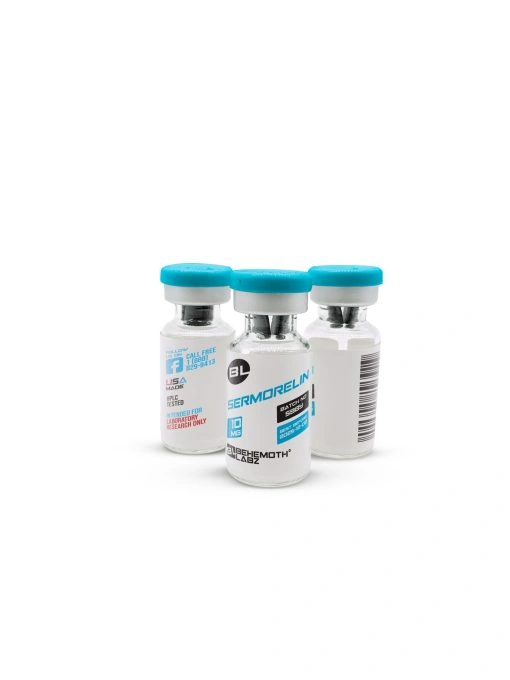
Product Details
Sermorelin is a synthetic peptide analog of growth hormone-releasing hormone (GHRH), composed of the first 29 amino acids of the endogenous GHRH sequence. This truncated structure retains receptor-binding capability, making it suitable for controlled experimental investigation.
Within laboratory environments, sermorelin is utilized to examine receptor-specific interactions and signaling activity associated with GHRH pathways. Its defined amino acid sequence allows for consistent evaluation of peptide-receptor dynamics in biochemical and molecular research systems.
This compound is supplied strictly for laboratory research purposes and is not intended for consumption, medical, or diagnostic applications.
Mechanism of Action
Sermorelin is characterized as a GHRH receptor agonist at the molecular level. It binds to growth hormone-releasing hormone receptors (GHRH-R), which are part of the G protein-coupled receptor (GPCR) family. Upon binding, this interaction initiates intracellular signaling cascades associated with cyclic adenosine monophosphate (cAMP) production.
The activation of these signaling pathways is studied in vitro to analyze receptor responsiveness, ligand-binding affinity, and downstream molecular events. This includes examination of second messenger systems and transcriptional activity linked to receptor stimulation.
Additionally, sermorelin’s structural specificity supports research into peptide-induced conformational changes in receptor proteins, contributing to a deeper understanding of endocrine signaling mechanisms and receptor-mediated pathway regulation under controlled experimental conditions.
Chemical Properties of Sermorelin
| Attribute | Details |
| Compound Name | Sermorelin |
| Classification | Synthetic GHRH analog peptide |
| Molecular Formula | C149H246N44O42S |
| Molecular Weight | 3357.9 g/mol |
| CAS Number | 86168-78-7 |
| IUPAC Name | H-Tyr-Ala-Asp-Ala-Ile-Phe-Thr-Asn-Ser-Tyr-Arg-Lys-Val-Leu-Gly-Gln-Leu-Ser-Ala-Arg-Lys-Leu-Leu-Gln-Asp-Ile-Met-Ser-Arg-NH2 |
| Primary Target | GHRH receptor (GPCR family) |
| Research Context | Receptor signaling and peptide interaction studies |
| Format | Research peptide (non-consumable) |
Research Applications
Receptor Binding and Activation Studies
Sermorelin is utilized in controlled experiments to evaluate ligand binding at GHRH receptor sites. Researchers analyze how peptide interaction influences receptor activation and signal initiation at the molecular level.
Intracellular Signaling Pathway Analysis
This compound is applied in studies examining signaling cascades associated with GPCR activation, particularly those involving cAMP-dependent pathways. These investigations focus on downstream molecular responses following receptor engagement.
Peptide Structure and Function Research
Sermorelin supports structural biology studies aimed at understanding the relationship between peptide configuration and receptor affinity. Its defined sequence enables detailed analysis of binding interactions and conformational dynamics.
Why Choose BehemothLabz to Buy Sermorelin for Research
BehemothLabz provides research-grade Sermorelin manufactured under controlled laboratory conditions with strict quality assurance protocols. Each batch undergoes analytical verification to ensure consistency in molecular composition and purity.
Comprehensive documentation, including laboratory testing reports and sourcing transparency, supports reproducibility in experimental settings. BehemothLabz maintains a compliance-focused approach, supplying compounds intended strictly for laboratory-based investigation and analytical research
Disclaimer
Sermorelin is intended strictly for laboratory research and analytical purposes only. It is not intended for use in diagnostic procedures, therapeutic applications, or in vivo studies of any kind.
Any references to biochemical pathways, receptor interactions, or enzymatic processes are provided solely for informational and research-context purposes. This compound must be handled exclusively by qualified professionals in controlled laboratory environments in accordance with applicable regulations and safety guidelines.
Improper handling or use outside of controlled research settings is strictly prohibited.
References
- Prakash, A., & Goa, K. L. (1999). Sermorelin: a review of its use in the diagnosis and treatment of children with idiopathic growth hormone deficiency. BioDrugs : clinical immunotherapeutics, biopharmaceuticals and gene therapy, 12(2), 139–157. https://doi.org/10.2165/00063030-199912020-00007
- Chang, Y., Huang, R., Zhai, Y., Huang, L., Feng, Y., Wang, D., Chai, R., Zhang, W., & Hu, H. (2021). A potentially effective drug for patients with recurrent glioma: sermorelin. Annals of translational medicine, 9(5), 406. https://doi.org/10.21037/atm-20-6561