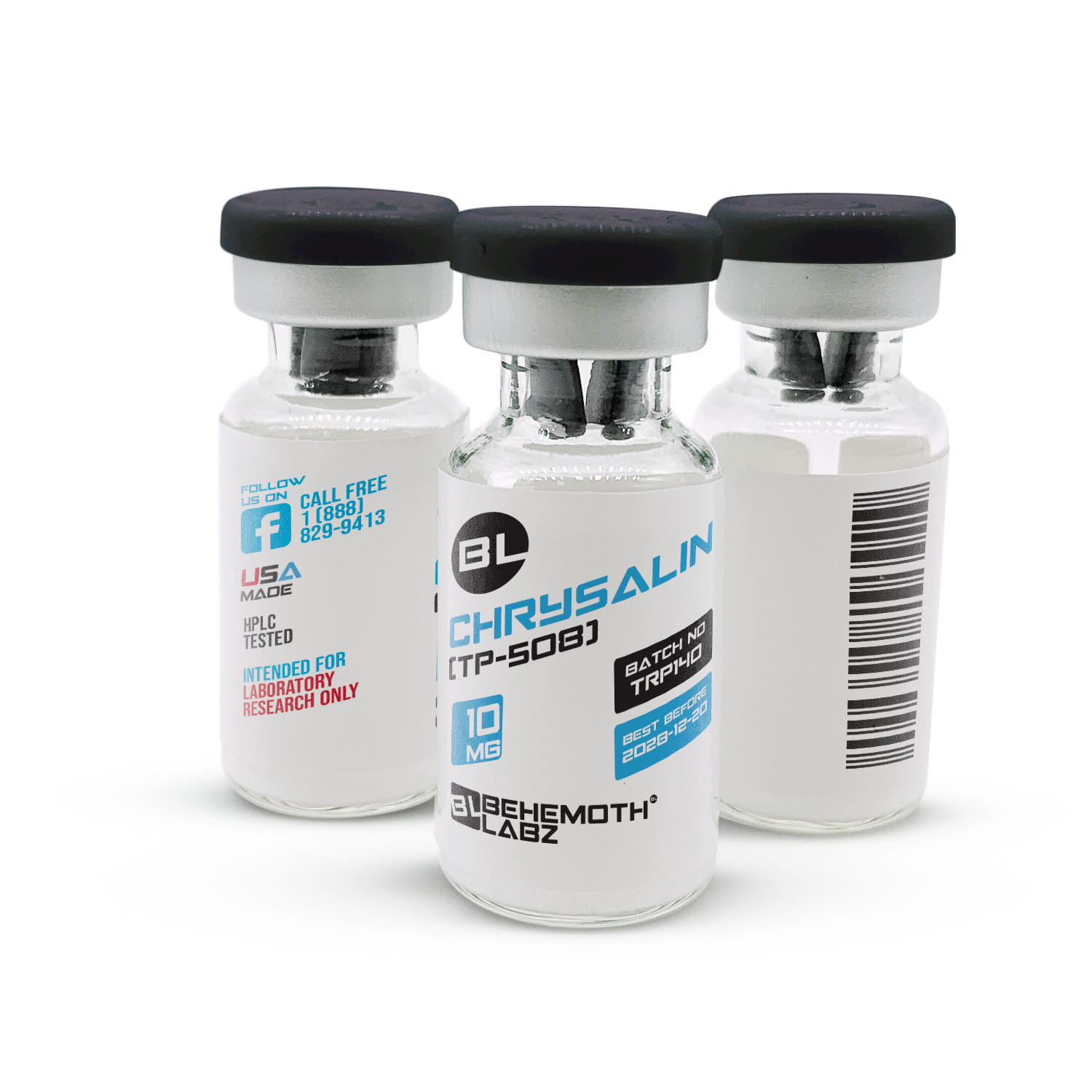
Product Details: Chrysalin (TP-508)
What is Chrysalin (TP-508)?
Chrysalin (TP-508), also known as rusalatide acetate, is a synthetic 23-amino acid peptide corresponding to residues 508-530 of prothrombin. It represents the high-affinity receptor-binding domain of the native thrombin molecule. It is a nonproteolytic thrombin peptide, meaning it does not activate the proteolytic cleavage cascade associated with thrombin’s coagulation function.
In laboratory settings, TP-508 is investigated for how it interacts with a distinct subset of thrombin receptors on:
- Fibroblasts
- Endothelial cells
- Stem cells
TP-508 is not a SARM, not a hormone analog, and not a dietary supplement. It is not approved by the FDA for human or veterinary use and is intended strictly for laboratory research purposes.
ATTENTION: This product is strictly for LABORATORY AND RESEARCH PURPOSES ONLY. Not for human or veterinary use.
Mechanism of Action of Chrysalin (TP-508)
Nonproteolytic Thrombin Receptor Binding and eNOS Activation
TP-508 has been investigated in preclinical cell culture systems as a nonproteolytic agonist at a distinct subset of thrombin receptors expressed on fibroblasts and endothelial cells. In isolated endothelial cell systems, TP-508 has been observed to stimulate endothelial nitric oxide synthase (eNOS) activation and rapid NO production.
Angiogenic Signaling and Endothelial Cell Motility
In preclinical animal wound healing models, TP-508 has been observed to stimulate endothelial cell chemokinesis and chemotaxis in a dose-dependent manner. Studies show increased vascularization markers at wound sites in TP-508-treated groups compared to saline controls.
Fibroblast Gene Expression Pathway
In isolated fibroblast cell systems, TP-508 has been investigated for its potential to modulate differential gene expression through a nonproteolytic receptor activation pathway. Preclinical data suggest this may involve upstream signaling events distinct from those initiated by proteolytically active thrombin.
Stem Cell Proliferation Pathway
In in vitro model systems, TP-508 has been investigated for its potential to affect stem cell proliferation signaling. Preclinical data from adipose tissue-derived stem cell cultures suggest that TP-508 may interact with the PI3K/Akt pathway.
Chemical Properties of Chrysalin (TP-508)
- Molecular Formula: C₉₇H₁₄₆N₂₈O₃₆S
- Molecular Weight: 2,312.44 g/mol
- CAS Number: 121341-81-9
- PubChem CID: 91668177
- Peptide Length: 23 amino acids
- Sequence: Ala-Gly-Tyr-Lys-Pro-Asp-Glu-Gly-Lys-Arg-Gly-Asp-Ala-Cys-Glu-Gly-Asp-Ser-Gly-Gly-Pro-Phe-Val
- Peptide Source: Residues 508–530 of human prothrombin
- IUPAC Name: H-Ala-Gly-Tyr-Lys-Pro-Asp-Glu-Gly-Lys-Arg-Gly-Asp-Ala-Cys-Glu-Gly-Asp-Ser-Gly-Gly-Pro-Phe-Val-OH
- Synonyms: TP508, Chrysalin, rusalatide acetate, TRAP-508
- Physical Form: White to off-white lyophilized powder
- Vial Format: lyophilized vial (flip-top aluminum crimp cap, sterile sealed)
- Solubility: Soluble in sterile water or 0.1% acetic acid solution
- Storage: −20°C, protected from light and moisture
- Classification: Research Use Only
Research Applications of Chrysalin (TP-508)
- Thrombin Receptor Binding Studies
TP-508 is studied in cell-free laboratory systems to understand how it attaches to a specific group of thrombin receptors without triggering the normal clotting process. Researchers use it as a reference compound to map which parts of its structure are responsible for this binding.
- Nitric Oxide Signaling Research
In isolated endothelial cell experiments, TP-508 has been observed to activate an enzyme called eNOS, which rapidly produces nitric oxide (NO). This makes it a useful research tool for studying how nitric oxide signaling works inside blood vessel cells under controlled conditions.
- Angiogenesis Research
TP-508 has been studied in preclinical wound healing models to observe how new blood vessels form.
- Integrin Signaling Research
A cell surface protein called αvβ3 integrin has been identified as one receptor through which TP-508 may send signals inside endothelial cells.
- Thrombin Fragment Comparison Studies
TP-508 is compared against other thrombin fragments in laboratory studies as well. The key distinction under investigation is that TP-508 binds to its receptor without activating the clotting cascade.
Risk & Handling
Chrysalin (TP-508) is a synthetic, nonproteolytic thrombin peptide. It is under investigation in preclinical research.
Risk Tier: MODERATE
This rating reflects TP-508’s bioactive receptor signaling activity at thrombin receptors, the bioactive concentrations used in preclinical research, and the need for proper handling to prevent accidental skin or inhalation exposure during reconstitution. Researchers must observe the following precautions at all times.
Handling Precautions: Chrysalin (TP-508) vials should be handled exclusively in a controlled laboratory environment by trained personnel. Use appropriate PPE at all times. Avoid direct skin and eye contact during reconstitution. Avoid inhalation.
Exposure Risks: No human safety data has been established for the research-grade formulation supplied here. Long-term or chronic toxicity data do not exist.
Storage: Store lyophilized TP-508 vials at −20°C in a dry, dark environment. Protect from light, heat, and moisture at all times. Avoid repeated freeze-thaw cycles. The vial seal should remain intact until use.
Why Choose BehemothLabz to Buy Chrysalin (TP-508) ?
Behemoth Labz supplies research-grade Chrysalin (TP-508) vials for laboratory and research purposes. It goes through quality control and third-party testing for consistency, purity, and research-grade standards. Chrysalin (TP-508) is supplied as a lyophilized powder in a sterile, sealed vial with a flip-top aluminum crimp cap. This specific format helps maintain peptide integrity under recommended cold storage conditions.
BehemothLabz Disclaimer
ATTENTION: All BehemothLabz products are strictly for LABORATORY AND RESEARCH PURPOSES ONLY. They are not to be used for any human or veterinary purposes.
Please make sure you go through the Terms and Conditions and familiarize yourself with them, as it is important. Kindly research the scientific uses of this product before making any purchases. Make note that the packaging and labels of the product may differ from those shown on the website.
Buying the product means you agree to our Terms and Conditions. You can contact our customer service team at support@behemothlabz.com if you are not fully satisfied with the product.
Chrysalin (TP-508) Research FAQs
What makes TP-508 nonproteolytic in research contexts?
TP-508 does not activate the proteolytic cleavage cascade associated with thrombin’s coagulation function otherwise. In preclinical settings, it interacts with a distinct receptor subset. This makes it a useful tool for isolating receptor-mediated signaling events in experimental models.
Is Chrysalin (TP-508) safe for human use?
No. Chrysalin (TP-508) is not approved by the FDA for human or veterinary use. Please review the Terms and Conditions before ordering.
What is the vial format for Chrysalin (TP-508) at BehemothLabz?
Chrysalin (TP-508) is supplied as a lyophilized powder in a sterile, sealed vial with a flip-top aluminum crimp cap. This format maintains peptide integrity under recommended cold storage conditions. It is the standard for research-grade lyophilized peptides.
References
- Olszewska-Pazdrak, B., Hart-Vantassell, A., & Carney, D. H. (2010). Thrombin peptide TP508 stimulates rapid nitric oxide production in human endothelial cells. Journal of Vascular Research, 47(3), 203–213. https://pubmed.ncbi.nlm.nih.gov/19893317/
- Hembrough, T. A., Swartz, G. M., Papathanassiu, A., et al. (2001). Thrombin peptide, TP508, stimulates angiogenic responses in animal models of dermal wound healing, in chick chorioallantoic membranes, and in cultured human aortic and microvascular endothelial cells. Journal of Vascular Research. https://pubmed.ncbi.nlm.nih.gov/11888680/
- Sower, L. E., Payne, D. A., Meyers, R., & Carney, D. H. (1999). Thrombin peptide, TP508, induces differential gene expression in fibroblasts through a nonproteolytic activation pathway. Experimental Cell Research, 247(2), 422–431. https://pubmed.ncbi.nlm.nih.gov/10066370/
- Freyberg, S., Song, Y. H., Muehlberg, F., & Alt, E. (2009). Thrombin peptide (TP508) promotes adipose tissue-derived stem cell proliferation via PI3 kinase/Akt pathway. Journal of Vascular Research, 46(2), 98–102. https://pubmed.ncbi.nlm.nih.gov/18607113/