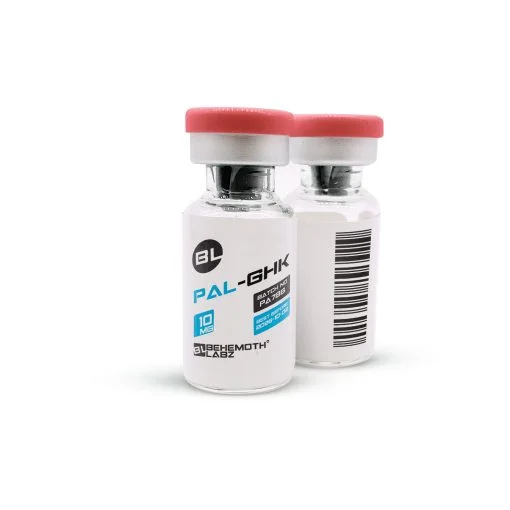
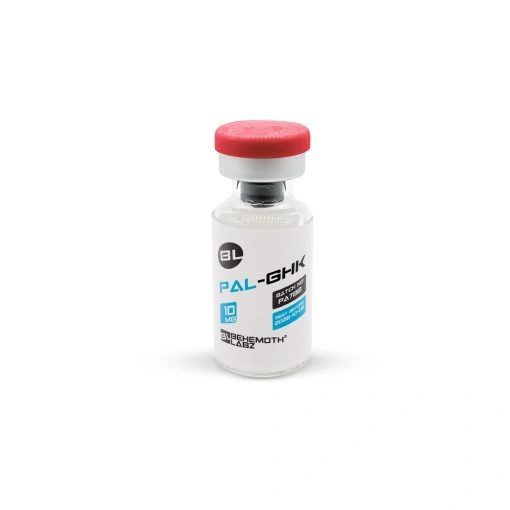
Product Details: PAL-GHK Peptide
PAL-GHK is a synthetic peptide composed of a palmitoyl (PAL) group conjugated to the tripeptide glycyl-L-histidyl-L-lysine (GHK). The addition of the palmitoyl group makes the peptide more attracted to fats. This may help it interact better with cell membranes and become more stable in research use. [1][4]
The GHK sequence has been widely studied in experiments for how it interacts with parts outside cells, like the extracellular matrix. It is also studied for its role in chemical signaling processes related to tissue structure. When the peptide is combined with a palmitoyl group, it may be delivered more effectively. At the same time, it still keeps its main functions. [2][5]
PAL-GHK is often used in research studies to examine how peptides interact with cells. It is also used to study changes in the extracellular matrix and how structure relates to function in controlled lab settings. [1]
Mechanism of Action
In experiments, the GHK part of PAL-GHK can bind to copper ions (Cu²⁺). These complexes take part in chemical processes related to regulating the extracellular matrix. These complexes are studied for how they affect enzymes like lysyl oxidase. This enzyme helps link collagen and elastin together. [2][3]
Studies indicate that GHK-related peptides influence gene expression patterns associated with extracellular matrix components, including collagen types and regulatory proteins. This includes affecting metalloproteinases (MMPs) and their inhibitors. These are important for keeping the extracellular matrix balanced in research studies. [2][5]
The palmitoyl addition does not change the main peptide sequence. It is studied for helping the peptide attach better to cell membranes and interact with cell structures. This may support improved intracellular signaling efficiency in in vitro systems. [1] [4]
Properties of PAL-GHK Peptide:
- Molecular Formula: C₃₁H₅₅N₆O ₅
- Molecular Weight: 592 g/mol
- CAS Number: 147732-56-7
- PubChem CID: 53398894
- Synonyms: Palmitoyl-GHK, Pal-GHK, Palmitoyl Glycyl-Histidyl-Lysine
Research Applications/Benefits of PAL-GHK Peptide:
- Extracellular Matrix and Collagen Pathway Investigation:
PAL-GHK is studied in experiments for its role in regulating the extracellular matrix (ECM). This includes processes related to collagen production, how structural proteins are arranged, and keeping the matrix stable. Studies on the GHK sequence show its involvement in fibroblast activity and collagen-related processes in in vitro systems. [2][3][5] - Matrix Metalloproteinase (MMP) Modulation:
GHK-derived peptides are studied for how they affect matrix metalloproteinases (MMPs) and their inhibitors. These proteins are important for breaking down and rebuilding the extracellular matrix. This modulation is important in maintaining balance between matrix synthesis and degradation in research models. [2] - Peptide Delivery and Membrane Interaction Studies: The palmitoyl modification is investigated for its role in enhancing peptide lipophilicity and membrane interaction. This property helps researchers study how the peptide can be delivered into cells. It also supports experiments on how the peptide interacts with fat-rich environments in lab models. [1][4]
Why Choose BehemothLabz for PAL-GHK Peptide?
Choose BehemothLabz, choose quality! We are among the few online sellers that believe in the integrity and purity of products. Our PAL-GHK Peptide is designed to meet the industrial criteria and the needs of researchers.Before launching our products, we test them through an independent laboratory to check their purity and ingredients. This procedure maximizes the accuracy and findings of your research experiments.
Additionally, we deliver nationwide and internationally. We use a secure payment system that safeguards your personal information and prevents unauthorized third-party access.
So, purchase PAL-GHK Peptide now and experience quality and purity for your research.
Disclaimer: This information is for educational purposes. We do not allow the human consumption of our products. All our products are sold for laboratory and research experiments.
References
- Castelletto, V., Hamley, I. W., Seitsonen, J., & Ruokolainen, J. (2013). Self-assembly of a model peptide amphiphile incorporating a GHK sequence. Langmuir, 29(21), 6471–6479.
- Pickart, L., & Margolina, A. (2018). Regenerative and protective actions of the GHK-Cu peptide in light of the new gene data. BioMed Research International, 2018, 1–11.
- Maquart, F. X., Pickart, L., Laurent, M., Gillery, P., Monboisse, J. C., & Borel, J. P. (1988). Stimulation of collagen synthesis in fibroblast cultures by the tripeptide-copper complex glycyl-L-histidyl-L-lysine-Cu²⁺. FEBS Letters, 238(2), 343–346.
- Lupo, M. P., & Cole, A. L. (2007). Cosmeceutical peptides. Dermatologic Therapy, 20(5), 343–349.
- Pickart, L. (2008). The human tripeptide GHK and tissue remodeling. Journal of Biomaterials Science, Polymer Edition, 19(8), 969–988.