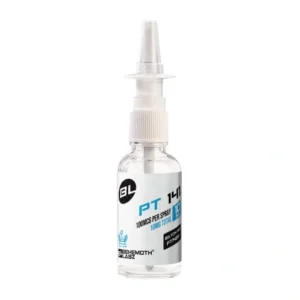

PEG MGF (Nasal Spray) – Product Details
PEG MGF, or Pegylated Mechano Growth Factor, is an investigational compound thought to possess neuroprotective properties. It is studied for effects on tissue growth pathways, and investigated for cellular responses in cardiac tissue models, affects tissue repair pathways, and aids in investigating effects on cardiac tissue processes in preclinical models.
PEG MGF is a synthetic version of Mechano Growth Factor (MGF) that has been modified with polyethylene glycol (PEG) for enhanced stability and duration of action. This modification allows PEG MGF to withstand enzymatic degradation and circulate for a longer period, potentially leading to more pronounced effects in research subjects.
It’s important to note that, despite the potential health benefits associated with PEG MGF, this compound remains among the research chemicals that require further investigation.
How Does PEG MGF Work?
PEG MGF works by targeting muscle tissues and promoting various cellular processes. It is believed to activate satellite cells, which are essential for muscle regeneration and repair. This activation is studied for its impact on cellular mechanisms involved in muscle regeneration in experimental models. As a result, PEG MGF is studied in research contexts related to tissue growth, wound healing, cardiac repair, and models of experimentally induced muscle damage.
Chemical Properties of PEG MGF
- CAS Number: Not applicable
- Molar Mass: Approximately 2867 to 2888 g/mol
- Chemical Formula: Not applicable
- IUPAC Name: Not applicable
- Also known by Synonyms as Pegylated Mechano Growth Factor
PEG MGF Research Findings
PEG MGF is an area of active research, and while its full range of potential applications is still being explored, several notable benefits have been identified:
Effects on Muscle Cell Activity
PEG MGF has been investigated in experimental models for its influence on muscle cell activation, proliferation, and differentiation. Research shows that it can modulate cellular mechanisms that contribute to structural adaptation and regeneration of muscle tissue under controlled laboratory conditions.
Role in Tissue Repair Pathways
In preclinical research, PEG MGF has been observed to affect pathways involved in tissue repair. Studies in animal and cell models show its capacity to increase regeneration and support cellular processes associated with recovery from experimentally induced muscle injury.
Influence on Cardiac Tissue Models
Experimental studies indicate that PEG MGF may impact cellular processes in cardiac tissue. Laboratory research has shown effects such as reduced programmed cell death in cardiac muscle cells and regulation of progenitor cell proliferation and migration in experimental conditions.
Impact on Skeletal Muscle Structure
PEG MGF has been studied for its effects on structural adaptations in skeletal muscle in preclinical models. Findings in mouse models show that specific administration protocols can increase mean muscle fiber size and influence muscle cell organization, providing insights into muscle tissue dynamics.
Note: PEG MGF is not FDA-approved for any medical or therapeutic use. It is strictly a research compound and is available for laboratory and experimental studies only.
Why Buy PEG MGF From Behemoth Labz
Behemoth Labz has established itself as a reliable and reputable source for research compounds since 2014. We take pride in offering the highest-quality products that are backed by independent, third-party-issued Certificates of Analysis for identification, purity, and concentration.
Our commitment to quality extends to every aspect of our business, from same-day processing to free shipping on all orders over $100 and our satisfaction guarantee.
At Behemoth Labz, we understand the importance of having access to the best compounds for research purposes. Our team is dedicated to providing exceptional customer service and ensuring that our customers have access to the compounds they need to conduct groundbreaking research.
We also offer international shipping to our customers around the world. Our team is committed to ensuring that your order arrives after research is needed to fully understand its mechanisms of action and potential applications in the treatment of various conditions.
DISCLAIMER
Please make sure you go through the Terms and Conditions, and please familiarize yourself with them as they are important. Please research the scientific uses of this product before making any purchases. Make note that the packaging and labels of the product may differ from those shown on the website.
Buying the product means you agree to our Terms and Conditions. You can contact our awesome customer service team at support@behemothlabz.com if you are not fully satisfied with the product.
ATTENTION: All BehemothLabz products are strictly for LABORATORY AND RESEARCH PURPOSES ONLY. They are not to be used for any human or veterinary purposes.
Reference Links
Deng, M., Zhang, B., Wang, K., Liu, F., Xiao, H., Zhao, J., Liu, P., Li, Y., Lin, F., & Wang, Y. (2010). Mechano growth factor E peptide promotes osteoblast proliferation and bone-defect healing in rabbits. International Orthopaedics, 35(7), 1099–1106. https://doi.org/10.1007/s00264-010-1141-2
Prashanth Kumar Kandalla, Goldspink, G., Butler-Browne, G., & Mouly, V. (2011). Mechano Growth Factor E peptide (MGF-E), derived from an isoform of IGF-1, activates human muscle progenitor cells and induces an increase in their fusion potential at different ages. Mechanisms of Ageing and Development, 132(4), 154–162. https://doi.org/10.1016/j.mad.2011.02.007
Philippou, A., Papageorgiou, E., Bogdanis, G., Halapas, A., Sourla, A., Maridaki, M., Pissimissis, N., & Koutsilieris, M. (2009). Expression of IGF-1 isoforms after exercise-induced muscle damage in humans: characterization of the MGF E peptide actions in vitro. In Vivo (Athens, Greece), 23(4), 567–575. https://pubmed.ncbi.nlm.nih.gov/19567392/
Golnar Doroudian, Pinney, J., Ayala, P., Los, T., Desai, T. A., & Russell, B. (2014). Sustained delivery of MGF peptide from microrods attracts stem cells and reduces apoptosis of myocytes. Biomedical Microdevices, 16(5), 705–715. https://doi.org/10.1007/s10544-014-9875-z
Harridge, S. D. R. (2003). Ageing and local growth factors in muscle. Scandinavian Journal of Medicine and Science in Sports, 13(1), 34–39. https://doi.org/10.1034/j.1600-0838.2003.20235.x