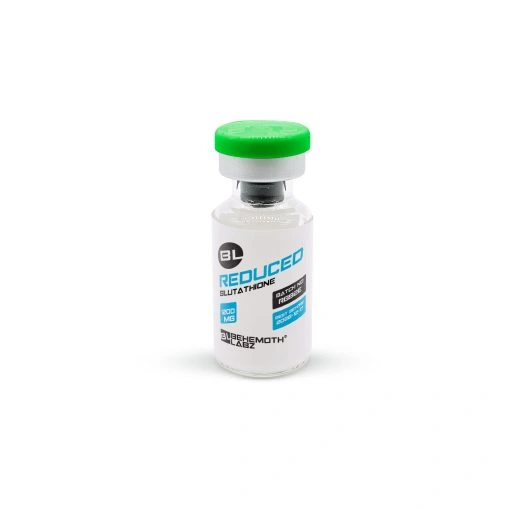
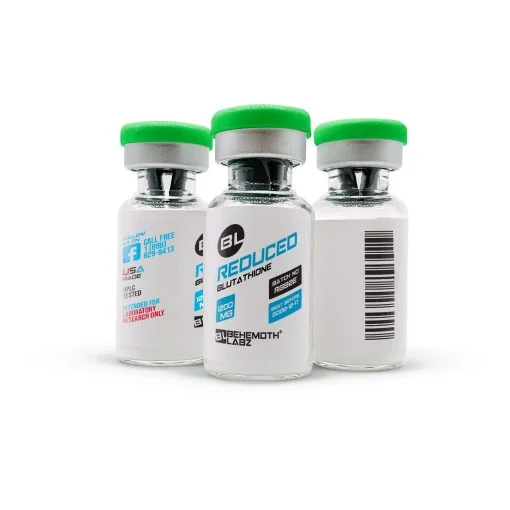
Product Details: Reduced Glutathione Peptide
Reduced glutathione (GSH) is a tripeptide composed of L-glutamate, L-cysteine, and glycine. The free thiol (-SH) group of cysteine allows GSH to participate in reversible redox reactions, including electron transfer to reactive oxygen species. [1]
Supplied as a pure, lyophilized peptide, GSH can be accurately reconstituted for in vitro studies investigating oxidative pathways, thiol-dependent enzymatic activity, and protein redox regulation. [2]
Mechanism of Action
GSH functions as a thiol-based redox agent in experimental systems. Its free sulfhydryl group enables reversible oxidation-reduction reactions. GSH interacts with enzymes such as
- Glutathione peroxidases (GPx)—catalyzing reduction of peroxides. [3]
- Glutathione S-transferases (GST)—mediating thiol conjugation to electrophiles. [4]
These interactions support the study of enzyme kinetics, substrate specificity, thiol-disulfide exchange, and protein modification under controlled laboratory conditions. GSH’s solubility and stability in aqueous buffers allow extended use in redox-sensitive assays and modeling of thiol-dependent biochemical pathways.
Properties of Reduced Glutathione Peptide:
- Molecular Formula: C₁₀H₁₇N₃O₆S
- Molecular Weight: 307.32 g/mol
- CAS Number: 70-18-8
- PubChem CID: 124886
- Synonyms: GSH; L-Glutathione reduced; γ-L-Glutamyl-L-cysteinylglycine
Research Applications/Benefits of Reduced Glutathione Peptide
- Redox Biology Studies: Investigate reactive oxygen species, oxidation-reduction reactions, and intracellular redox regulation in vitro. [5]
- Enzyme Interaction Analysis: Characterize thiol-dependent enzymes such as GPx and GST, including kinetics and substrate specificity. [6]
- Protein Modification Experiments: Examine thiol-disulfide exchange and reversible modifications of proteins under controlled conditions. [7]
- Oxidative Stress Modeling: Quantify antioxidant activity and study redox-dependent biochemical processes in cell-free or cell-based assays. [8]
Why Choose BehemothLabz for Reduced Glutathione Peptide?
Choose BehemothLabz, choose quality! We are among the few online sellers that believe in the integrity and purity of products. Our reduced glutathione peptide is designed to meet industrial criteria and researchers’ needs.Before launching our products, we test them through an independent laboratory to check their purity and ingredients. This procedure maximizes the accuracy and findings of your research experiments.
Additionally, we deliver nationwide and internationally. We use a secure payment system that safeguards your personal information and prevents unauthorized third-party access.
So, purchase reduced glutathione peptide now and experience quality and purity for your research.
Disclaimer: This information is for educational purposes. We do not allow the human consumption of our products. All our products are sold for laboratory and research experiments.
References:
- Locigno, R., & Castronovo, V. (2001). Reduced glutathione system: Role in cancer development, prevention and treatment (Review). International Journal of Oncology, 19(2), 221–236.
- Zaffagnini, M., Fermani, S., Marchand, C. H., Costa, A., Sparla, F., Rouhier, N., Geigenberger, P., Lemaire, S. D., & Trost, P. (2018). Redox homeostasis in photosynthetic organisms: Novel and established Thiol-Based Molecular mechanisms. Antioxidants and Redox Signaling, 31(3), 155–210.
- Margis, R., Dunand, C., Teixeira, F. K., & Margis‐Pinheiro, M. (2008). Glutathione peroxidase family – an evolutionary overview. FEBS Journal, 275(15), 3959–3970.
- Board, P. G., & Anders, M. W. (2006). Glutathione Transferase Omega 1 Catalyzes the Reduction of S-(Phenacyl)glutathiones to Acetophenones. Chemical Research in Toxicology, 20(1), 149–154.
- Reuter, W. H., Masuch, T., Ke, N., Lenon, M., Radzinski, M., Van Loi, V., Ren, G., Riggs, P., Antelmann, H., Reichmann, D., Leichert, L. I., & Berkmen, M. (2019). Utilizing redox-sensitive GFP fusions to detect in vivo redox changes in a genetically engineered prokaryote. Redox Biology, 26, 101280.
- Lambert, N., & Freedman, R. B. (1983). Kinetics and specificity of homogeneous protein disulphide-isomerase in protein disulphide isomerization and in thiol-protein-disulphide oxidoreduction. Biochemical Journal, 213(1), 235–243.
- Gilge, J. L., Fisher, M., & Chai, Y. (2008). The effect of oxidant and the Non-Oxidant alteration of cellular thiol concentration on the formation of protein Mixed-Disulfides in HEK 293 cells. PLoS ONE, 3(12), e4015.
- Aliaga-Tobar, V., Torres, J., Mendoza, S. N., Gálvez, G., Ortega, J., Gómez, S., Parra, V., Arenas, F., Maass, A., Siegel, A., González, M., & Latorre, M. (2025). Reduced glutathione levels in Enterococcus faecalis trigger metabolic and transcriptional compensatory adjustments during iron exposure. mSystems, 11(1), e0124025.