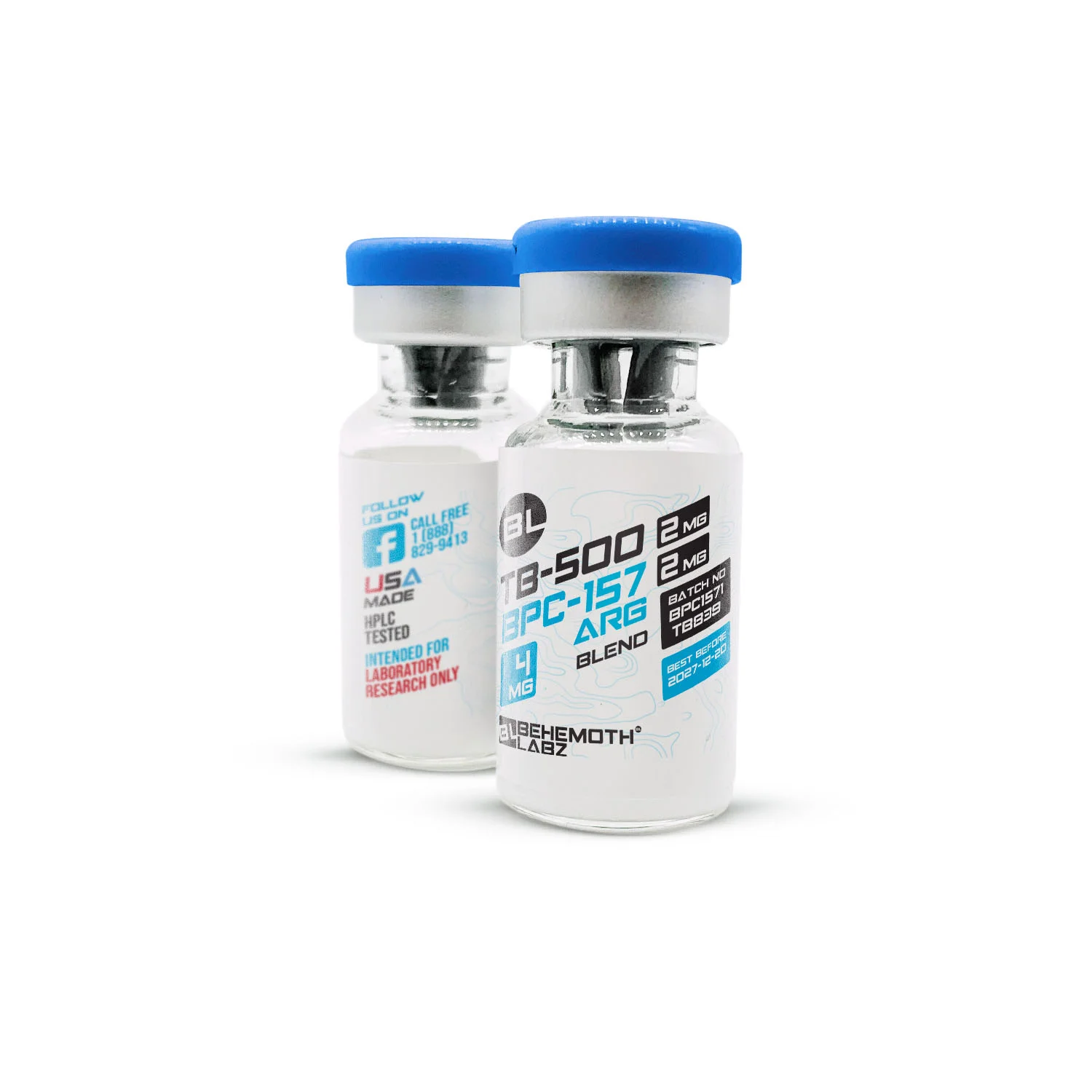


What is BPC-157 + TB-500 Nasal Spray?
BPC-157 + TB-500 Nasal Spray is a dual-peptide research formulation. It combines two distinct synthetic peptides in a single delivery format. Each spray delivers 100 mcg of BPC-157 and 100 mcg of TB-500. Total delivery is 200 mcg per spray and 20 mg per bottle.
BPC-157 (Body Protection Compound-157) is a synthetic pentadecapeptide derived from a stable fragment of a naturally occurring protein. This is commonly found in gastric juice. In preclinical models, it is studied to assess its influence on cellular signaling pathways involved in:
- Tissue remodeling
- Angiogenesis, and
- Nitric oxide modulation
On the other hand, TB-500 is a synthetic analog of Thymosin Beta-4. It is a 43-amino acid peptide found in virtually all mammalian cells. In laboratory settings, it is investigated for its role in actin dynamics and cell migration. These are processes central to the study of tissue repair in experimental models.
This nasal spray format is used in research settings as a delivery method that allows investigators to study peptide uptake and systemic distribution without gastrointestinal degradation.
Disclaimer: BPC-157 + TB-500 Nasal Spray is a research compound not approved by the U.S. Food and Drug Administration (FDA) for human or veterinary use. It is not intended to diagnose, treat, cure, or prevent any disease. This product is strictly for laboratory research purposes only.
ATTENTION: This product is strictly for LABORATORY AND RESEARCH PURPOSES ONLY. Not for human or veterinary use.
Mechanism of Action of BPC-157 + TB-500 Nasal Spray
BPC-157 Working in Preclinical Models
BPC-157 is thought to exert its effects in preclinical models primarily through modulation of the nitric oxide (NO) system and activation of growth factor signaling pathways. Specifically, experimental data suggest it interacts with VEGFR2 via Src-caveolin-1-eNOS and PI3K-Akt-eNOS axes. This is thought to affect angiogenic activity, fibroblast behavior, and collagen organization in tissue repair models.
Key mechanistic observations from laboratory studies:
- VEGF upregulation: BPC-157 is thought to upregulate VEGF expression. This can stimulate angiogenesis at sites of tissue disruption in animal models
- ERK1/2 activation: Studies in preclinical settings have observed activation of extracellular signal-regulated kinases. This plays a role in cellular proliferation and survival
- Nitric oxide modulation: BPC-157 is thought to interact with the NO pathway, influencing vascular tone and microvascular integrity.
- Collagen and fibroblast activity: In animal studies, BPC-157 has been associated with altered fibroblast activity and collagen deposition patterns.
TB-500 Working in Preclinical Models
TB-500 is thought to work primarily through the regulation of actin dynamics. It binds G-actin monomers with high affinity, sequestering monomeric actin and controlling its availability for polymerization. This process is central to cellular motility in experimental models as it directs the movement of cells during wound-closure assays.
Key mechanistic observations from laboratory studies:
- G-actin sequestration: TB-500 binds monomeric G-actin, regulating the pool available for filament polymerization.
- Cell migration: In vitro studies have observed TB-500 influencing the migration of keratinocytes, endothelial cells, and fibroblasts in wound models
- Integrin-linked kinase (ILK) activation: Preclinical data suggest Thymosin Beta-4 activates ILK, which may play a role in cell survival signaling in experimental cardiac models
- Angiogenic signaling: TB-500 has been observed to stimulate endothelial cell migration and tube formation in in vitro angiogenesis assays.
Why combine BPC-157 and TB-500?
In laboratory settings, BPC-157 and TB-500 are studied together because they are thought to operate through mechanistically distinct but potentially complementary pathways. BPC-157 is primarily investigated for its effects on angiogenic and NO-mediated signaling. TB-500 is studied for its role in actin-dependent cell migration. Researchers use this combination to probe whether these distinct pathways interact or produce additive effects in tissue repair models.
Chemical Properties of BPC-157 + TB-500 Nasal Spray
BPC-157
| Property | Detail |
| Molecular Formula | C₆₂H₉₈N₁₆O₂₂ |
| Molecular Weight | 1,419.5 g·mol⁻¹ |
| Purity | ≥99% (HPLC verified, per batch COA) |
| Physical Form | White lyophilized powder |
| Storage | −20°C, protected from light and moisture |
| Classification | Research Use Only (RUO) |
TB-500
| Property | Detail |
| Molecular Formula | C₃₄H₆₀N₁₀O₁₄ |
| Molecular Weight | 824.9 g/mol |
| Purity | ≥99% (HPLC verified, per batch COA) |
| Physical Form | White lyophilized powder |
| Storage | −20°C, protected from light and moisture |
| Classification | Research Use Only (RUO) |
Blend Specification
| Property | Detail |
| BPC-157 per spray | 100 mcg |
| TB-500 per spray | 100 mcg |
| Total per spray | 200 mcg |
| Total per bottle | 20 mg (10 mg BPC-157 + 10 mg TB-500) |
| Format | Nasal spray solution |
| Origin | USA-made |
Research Applications of BPC-157 + TB-500 Nasal Spray
- Angiogenesis Pathway Research
In preclinical models, BPC-157 has been investigated for its potential to upregulate VEGF expression and CD34 markers in muscle and tendon tissue research. This suggests involvement in neovascularization processes.
- Cell Migration and Actin Dynamics Studies
TB-500’s high-affinity binding to G-actin makes it a tool for investigating how cytoskeletal regulation affects cell migration in wound-closure and tissue-remodelling assays.
- Gastrointestinal Tissue Research
BPC-157 is derived from a gastric protein fragment and is investigated in preclinical GI models for how it may influence mucosal signaling, inflammatory pathway modulation, and cellular proliferation.
- Musculoskeletal Model Research
Risk and Handling Precautions
Risk Tier: MODERATE
This rating reflects both peptides’ bioactive activity at angiogenic and cytoskeletal signaling pathways in preclinical models, the absence of established human safety profiles for either compound, and the additional handling considerations specific to intranasal formulations. Researchers must observe the following precautions at all times.
Handling Precautions: BPC-157 + TB-500 Nasal Spray should be handled by trained laboratory personnel only. Use appropriate personal protective equipment (PPE) at all times, including gloves and eye protection. Avoid direct skin contact, inhalation, or accidental mucosal exposure during laboratory handling.
Exposure Risks: Both are research compounds with no approved safety profiles for human exposure. No human toxicity data exists for either peptide in this formulation.
Storage: Store at −20°C in a dry, dark environment protected from light, heat, and moisture. Check the batch Certificate of Analysis for lot-specific guidance. Do not use if the seal has been compromised.
Toxicity and Data Limitations: No chronic toxicity data exist for this blend. All findings are from short-duration preclinical models only.
Why Choose BehemothLabz for Research-Grade BPC-157 + TB-500 Nasal Spray?
BehemothLabz supplies BPC-157 + TB-500 Nasal Spray for laboratory and research purposes. Every batch is independently tested by third-party laboratories for purity and identity. A Certificate of Analysis is publicly available for each lot. BehemothLabz does not self-certify.
The compound is USA-made and held to research-grade standards. It is available strictly to qualified researchers for use in controlled laboratory environments.
BehemothLabz Disclaimer
ATTENTION: All BehemothLabz products are strictly for LABORATORY AND RESEARCH PURPOSES ONLY. They are not to be used for any human or veterinary purposes.
Please make sure you go through the Terms and Conditions and familiarize yourself with them, as it is important. Kindly research the scientific uses of this product before making any purchases. Make note that the packaging and labels of the product may differ from those shown on the website.
Buying the product means you agree to our Terms and Conditions. You can contact our customer service team at support@behemothlabz.com if you are not fully satisfied with the product.
BPC-157 + TB-500 Nasal Spray Research FAQs
How does BPC-157 differ from TB-500 mechanistically?
In preclinical models, BPC-157 is primarily associated with angiogenic and nitric oxide signaling pathways. TB-500 operates primarily through actin dynamics: it binds G-actin monomers to regulate the monomeric actin pool, which is thought to influence cell migration in experimental wound models. They are mechanistically distinct peptides studied together for possible complementary effects.
What does each spray deliver?
Each spray delivers 100 mcg of BPC-157 and 100 mcg of TB-500, for a combined 200 mcg per spray. Each bottle contains 20mg total.
Is BPC-157 + TB-500 Nasal Spray approved for human use?
No. Neither peptide in this blend is approved by the FDA for human or veterinary use. No regulatory body has cleared this formulation for any health application. This product is for laboratory research only.
Is TB-500 the same as Thymosin Beta-4?
No. TB-500 is a synthetic fragment of Thymosin Beta-4. It comprises residues 17-23 and retains the actin-binding motif of the parent peptide. Full-length Thymosin Beta-4 is a 43-amino acid peptide. Research findings from full-length Tβ4 studies cannot be assumed to apply directly to the fragment.
What purity standard does BehemothLabz provide for this blend?
Every batch is independently tested by third-party laboratories. Both BPC-157 and TB-500 are verified at ≥99% purity by HPLC analysis. A Certificate of Analysis confirming purity and molecular identity is available per lot.
How should BPC-157 + TB-500 Nasal Spray be stored?
Store at −20°C in a dry, dark environment protected from light, heat, and moisture. Check the batch Certificate of Analysis for lot-specific guidance. Do not use it if the seal has been compromised.
References
- Brcic L, Brcic I, Staresinic M, Novinscak T, Sikiric P, Seiwerth S. Modulatory effect of gastric pentadecapeptide BPC 157 on angiogenesis in muscle and tendon healing. Journal of Physiology and Pharmacology. 2009;60(Suppl 7):191–196. Available at: https://pubmed.ncbi.nlm.nih.gov/20388964/
- Bock-Marquette I, Saxena A, White MD, Dimaio JM, Srivastava D. Thymosin beta4 activates integrin-linked kinase and promotes cardiac cell migration, survival, and cardiac repair. Nature. 2004;432(7016):466–472. Available at: https://pubmed.ncbi.nlm.nih.gov/15565145/