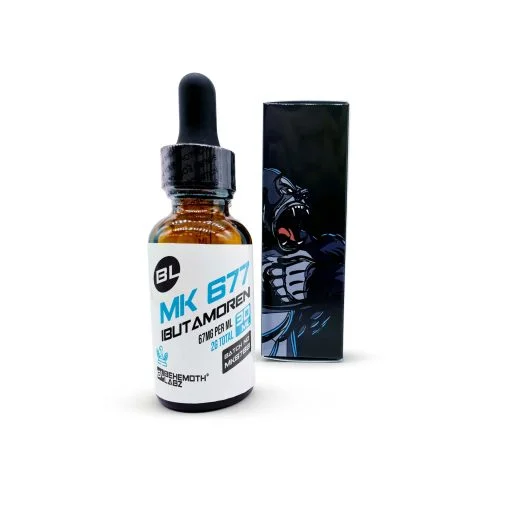
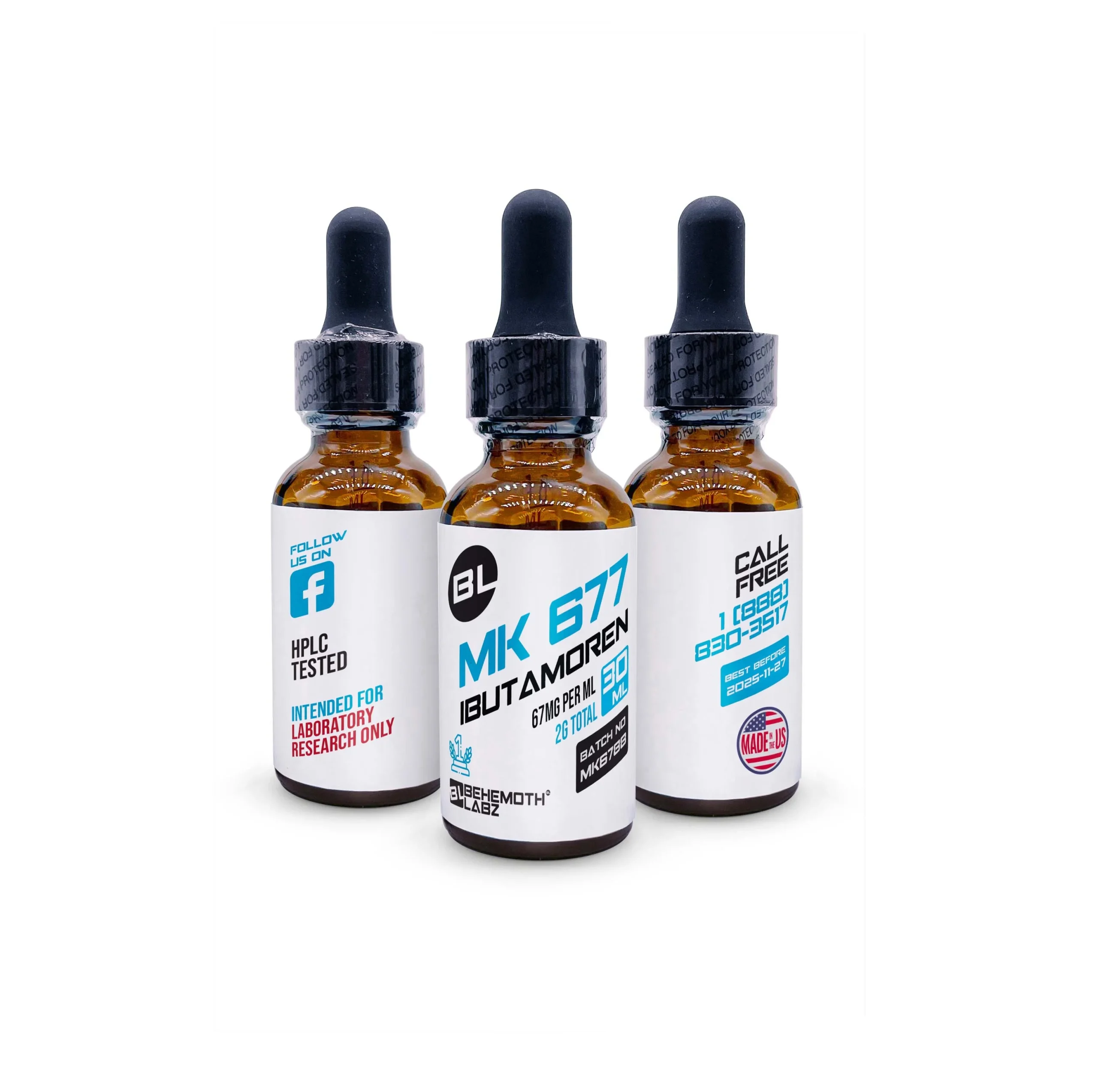
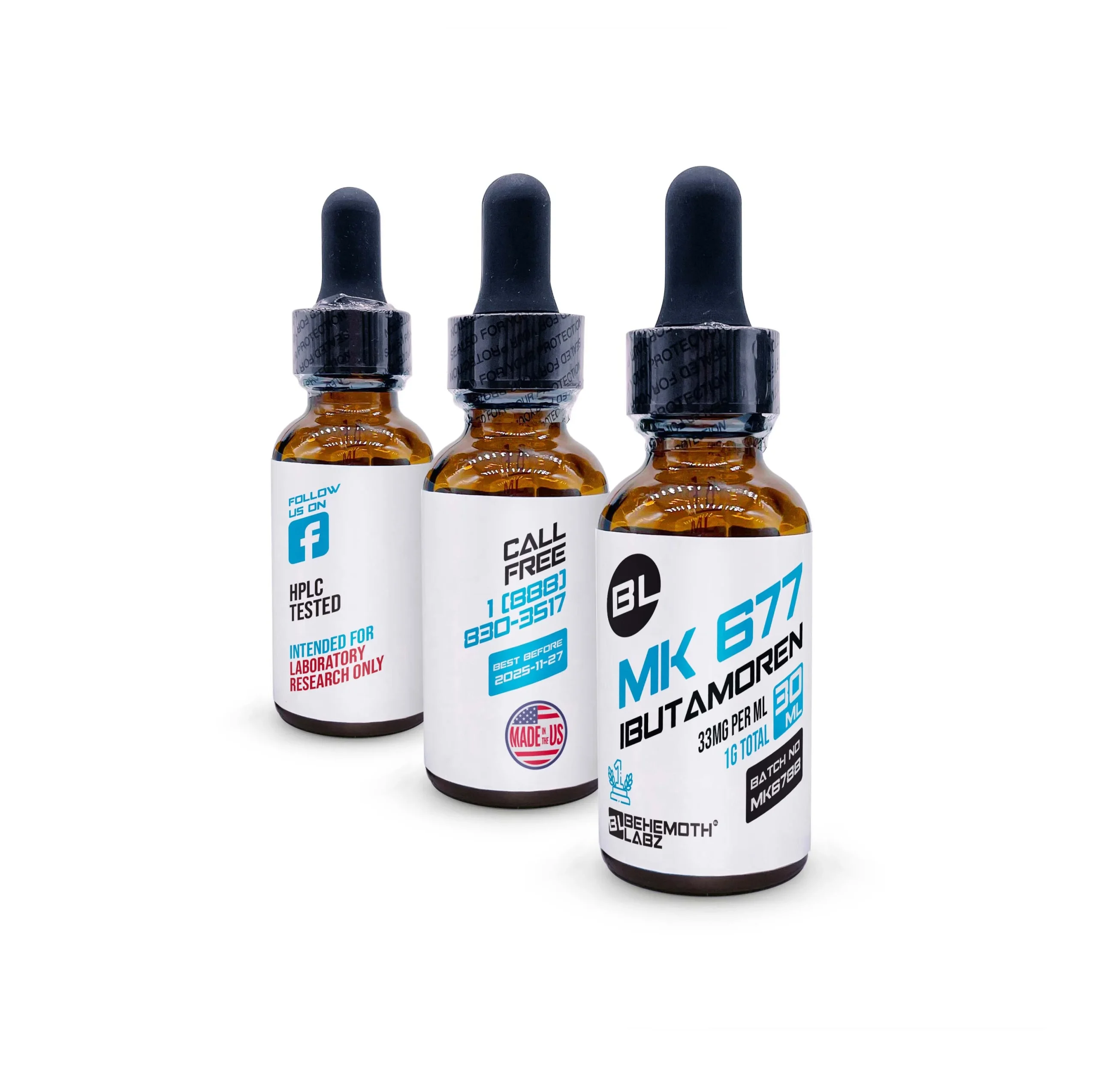
Product Details: MK-677 Ibutamoren Liquids
MK-677 (Ibutamoren) is a synthetic compound supplied exclusively for laboratory research purposes. It is commonly utilized in experimental settings to investigate somatotropic axis signaling and related biochemical pathways.
These pathways may include the mechanisms associated with growth hormone (GH) and insulin-like growth factor 1 (IGF-1) regulation in research experimental models.
A few studies have indicated that, under controlled experimental conditions, MK-677 may modulate circulating GH and IGF-1 levels.
This material is intended strictly for scientific and laboratory-based research applications. It is not designed for therapeutic, diagnostic, or consumable use.
Properties of MK-677 Ibutamoren Liquids
- CAS Number is stated as 159634-47-6
- Molar Mass is 528.67 g·mol−1
- It has a Chemical Formula of C27H36N4O5S
- IUPAC Name is: 2-amino-2-methyl-N-[1-(1-methylsulfonylspiro[2H-indole-3,4′-piperidine]-1′-yl)-1-oxo-3-phenylmethoxypropan-2-yl]propanamide
- Synonyms: MK-677; MK-0677; L-163,191; Oratrope
Proposes Working Mechanism of MK-677
MK-677 Liquid is a non-peptidic agonist of the growth hormone secretagogue receptor (GHSR-1a). In research preclinical models, MK-677 has been shown to work by activating Gαq/11-coupled intracellular signaling pathways.
This leads to upregulation of somatotropic-axis–associated peptide signaling and downstream anabolic mediator expression in experimental models.
Researchers also believe that the compound demonstrates sustained receptor activation consistent with extended half-life kinetics. Plus, it may exhibit no significant affinity for androgen receptor pathways.
Possible Research Applications of MK-677
MK-677 is an investigational compound that may have possible applications in the research field. A few of its potential applications that researchers have observed include:
Signal pathway modulation studies
It is used to examine GHSR-1a receptor activation and downstream signaling cascade dynamics.
Biochemical process analysis
The compound may evaluate changes in glucose-related and lipid-associated molecular pathways in research models.
Anabolic signaling investigation
It is utilized to study alterations in synthesis-related pathways and associated molecular responses in controlled systems.
Why Choose to Buy MK-677 Liquids from Behemoth Labz?
You can buy Behemoth Labz MK677 for research purposes. We offer MK677 for sale, which is
tested for:
- Purity
- Identity
- Contaminants.
The Techniques include:
- HPLC (High Performance Liquid Chromatography)
- FTIR spectroscopy.
You can verify lab results as each product batch gets a unique batch number. It is linked to a Certificate of Analysis (COA). The COAs are supposed to be accessible via product pages.
BehemothLabz Disclaimer
ATTENTION: All BehemothLabz products are strictly for LABORATORY AND RESEARCH PURPOSES ONLY. They are not to be used for any human or veterinary purposes.
Please make sure you go through the Terms and Conditions, and familiarize yourself with them, as they are important. Kindly research the scientific uses of this product before making any purchases. Make note that the packaging and labels of the product may differ from those shown on the website. Buying the product means you agree to our Terms and Conditions.
Reference Links
- Murphy, M. G., Plunkett, L. M., Gertz, B. J., He, W., Wittreich, J., Polvino, W. M., & Clemmons, D. R. (1998). MK-677, an orally active growth hormone secretagogue, reverses diet-induced catabolism. The Journal of Clinical Endocrinology and Metabolism, 83(2), 320–325. https://doi.org/10.1210/jcem.83.2.4551
- Lee, J., Kwon, A., Chae, H. W., Lee, W. J., Kim, T. H., & Kim, H. S. (2018). Effect of the Orally Active Growth Hormone Secretagogue MK-677 on Somatic Growth in Rats. Yonsei Medical Journal, 59(10), 1174–1180. https://doi.org/10.3349/ymj.2018.59.10.1174
- Smith, R. G., & Thorner, M. O. (2023). Growth Hormone Secretagogues as Potential Therapeutic Agents to Restore Growth Hormone Secretion in Older Subjects to Those Observed in Young Adults. The Journals of Gerontology: Series A, 78(Supplement_1), 38–43. https://doi.org/10.1093/gerona/glad022