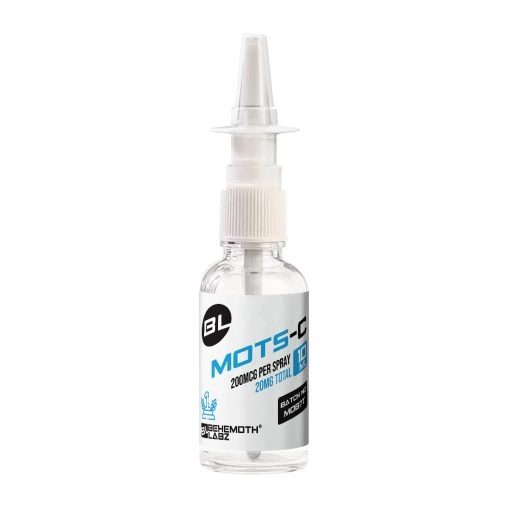
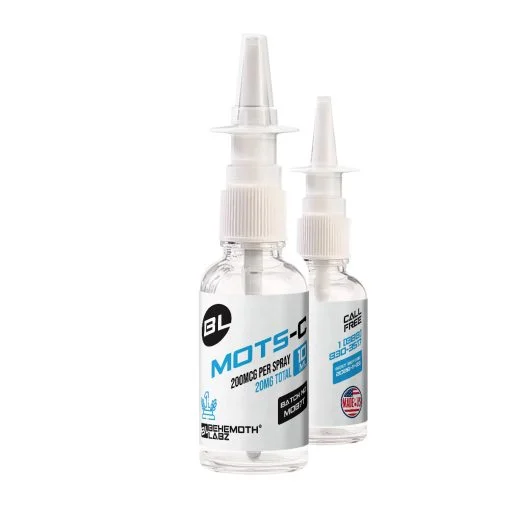
MOTS‑C Nasal Spray contains a lab-grade MOTS‑C peptide, a 16-amino-acid mitochondrial-derived peptide (MDP). MOTS‑C is naturally encoded in mitochondrial DNA and studied in preclinical models for its role in cellular energy homeostasis and metabolic regulation.
This nasal spray formulation allows MOTS‑C to bypass initial metabolic processing, facilitating investigational delivery to tissues in research models. This product is intended strictly for laboratory and experimental use.
Mechanism of Action
MOTS‑C peptide nasal spray is synthesized in mitochondria, the energy-producing organelles of cells. In experimental models [1]. MOTS‑C can translocate into cells and interact with energy-sensing proteins, particularly AMP-activated protein kinase (AMPK). Activation of AMPK functions as a regulatory switch, modulating glucose and lipid metabolism to maintain cellular energy balance under low-energy or metabolic stress conditions [2].
Under energy-limited conditions, MOTS C peptide nasal spray has been observed in preclinical studies to translocate to the nucleus, where it interacts with transcriptional regulators controlling genes associated with energy production and adaptive responses. These interactions influence glucose uptake, lipid processing, and cellular energy storage, making MOTS‑C a valuable investigational compound for studying molecular mechanisms of metabolic adaptation.
Properties of MOTS-C Nasal Spray:
- Molecular Formula: C₁₀₁H₁₅₂N₂₈O₂₂S₂
- Molecular Weight: 2174.6 g/mol
- CAS Number: Not widely standardized
- PubChem CID: 146675088
- Synonyms: MOTS‑C, mitochondrial-derived peptide (trifluoroacetate salt)
Research Applications/Benefits MOTS-C Nasal Spray
- Energy and Metabolic Signaling: Investigational studies show that MOTS‑C activates AMPK, supporting research into cellular energy regulation in preclinical models [3].
- Gene Expression Modulation: MOTS‑C translocation to the nucleus can influence transcriptional programs associated with metabolic adaptation in experimental systems [4].
- Metabolic Pathway Research: Utilized in laboratory studies to examine glucose and lipid utilization pathways under controlled metabolic challenges [5].
- Cellular Adaptation Studies: MOTS‑C assists in mechanistic investigations of how cells respond to energy stress at a molecular level [6].
- AMPK Pathway Investigation: Serves as a tool for studying AMPK-mediated signaling and adaptive energy regulation in preclinical research models [7].
Why Choose Behemoth Labz to Buy MOTS-C Nasal Spray
Choose Behemoth Labz, choose quality! We are among the few online sellers that believe in the integrity and purity of products. Our MOTS-C Nasal Spray is designed to meet the industrial criteria and the needs of researchers.
Before launching our products, we test them through an independent laboratory to check their purity and ingredients. This procedure maximizes the accuracy and findings of your research experiments.
Additionally, we deliver nationwide and internationally. We use a secure payment system that safeguards your personal information and prevents unauthorized third-party access.
So, purchase MOTS-C Nasal Spray now and experience quality and purity for your research.
Disclaimer: This information is for educational purposes. We do not allow the human consumption of our products. All our products are sold for laboratory and research experiments.
References:
- Basu, U., Bostwick, A. M., Das, K., Dittenhafer-Reed, K. E., & Patel, S. S. (2020b). Structure, mechanism, and regulation of mitochondrial DNA transcription initiation. Journal of Biological Chemistry, 295(52), 18406–18425.
- Tang, M., Su, Q., Duan, Y., Fu, Y., Liang, M., Pan, Y., Yuan, J., Wang, M., Pang, X., Ma, J., Laher, I., & Li, S. (2023). The role of MOTS-c-mediated antioxidant defense in aerobic exercise alleviating diabetic myocardial injury. Scientific Reports, 13(1).
- Yuan, Y., Wang, F., Liu, X., Shuai, B., & Fan, H. (2023b). The role of AMPK signaling in ulcerative colitis. Drug Design Development and Therapy, Volume 17, 3855–3875.
- González-Arzola, K., & Díaz-Quintana, A. (2023). Mitochondrial factors in the cell nucleus. International Journal of Molecular Sciences, 24(17), 13656.
- Wang, P., Huang, L., Zhu, Z., Hu, X., Wu, B., & Yang, X. (2025). Mediation of fasting blood glucose between relative muscle strength and hypertension: insights from two cohorts. Diabetology & Metabolic Syndrome, 17(1), 372.
- Frańczak, M., Gargaś, J., & Sypecka, J. (2026). Mitochondria as a therapeutic target in neurodegeneration caused by hypoxia and ischemia during the perinatal period. Pharmacological Reports, 78(1), 1–26.
- Xia, W., Li, S., Li, L., Zhang, S., Wang, X., Ding, W., Ding, L., Zhang, X., & Wang, Z. (2023). Role of anthraquinones in combating insulin resistance. Frontiers in Pharmacology, 14.